A Pledge Is Not a Repair Ship
Seventeen countries signed a framework to protect the undersea cables last week. It is voluntary, unfunded, and excludes the two countries with the largest navies. Britain built something better in 1902, and it did it on purpose.
On May 30, on the sidelines of the Shangri-La Dialogue in Singapore, seventeen countries launched a framework called GUIDE, the Guiding Principles for Underwater Infrastructure Defence Exchanges. The signatories are Singapore, Britain, France, Italy, the Netherlands, Sweden, Finland, Estonia, Latvia, Lithuania, Australia, New Zealand, the Philippines, Malaysia, Brunei, Thailand, and Qatar. The framework is, in the explicit language of the people who wrote it, voluntary, non-legally binding, and non-financially binding. It exists to share information and best practices and to improve crisis response should the need arise. It is, functionally, a very serious group chat.
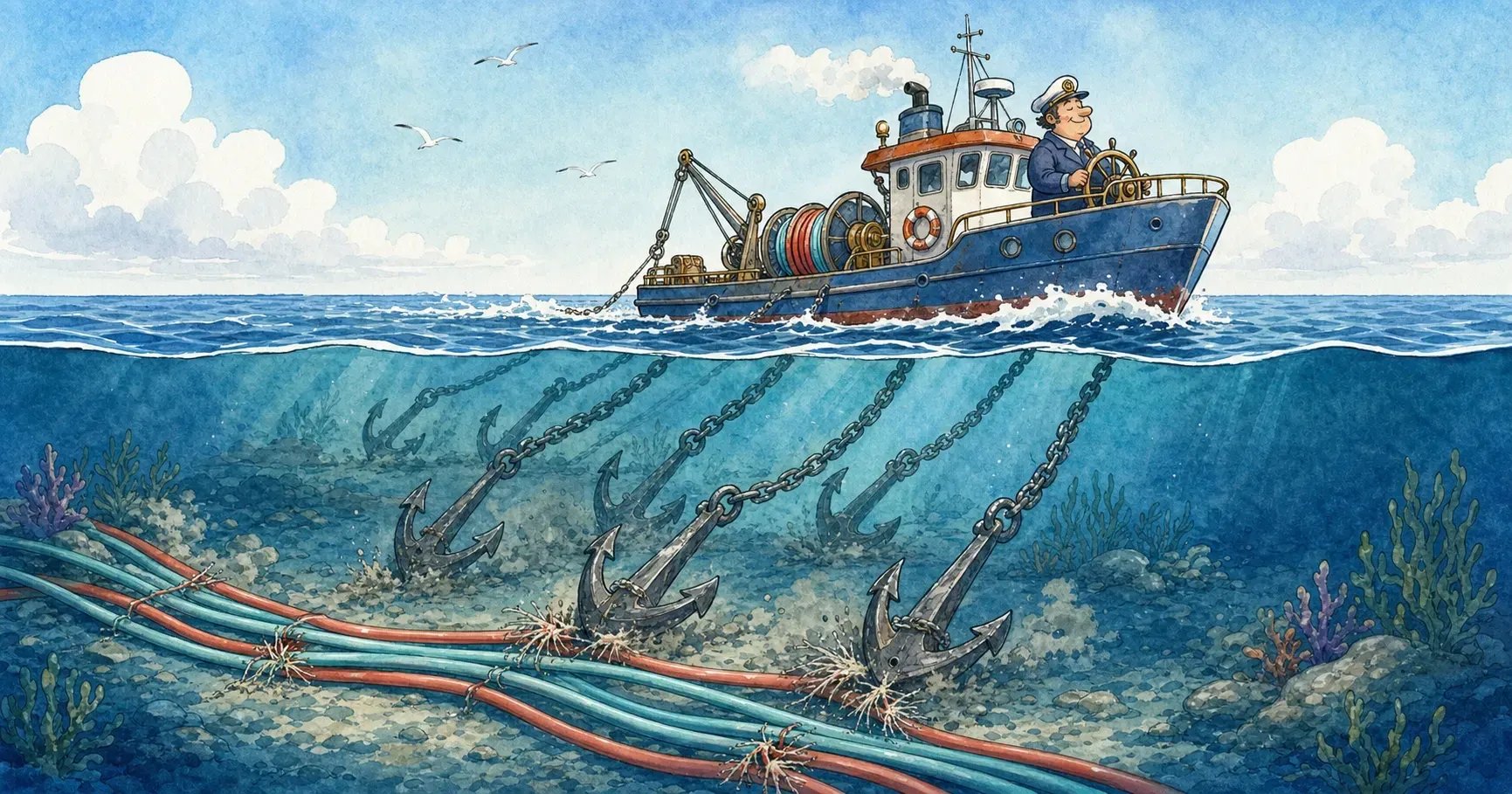
I want to be fair to it, because the diagnosis underneath it is exactly right, and it took the world an embarrassingly long time to articulate. There are more than 550 submarine cables on the seabed, running over a million kilometers, and they carry something like ninety-nine percent of the data that moves between continents. That's ninety-nine percent of everything: interbank settlement, military traffic, the API call your phone makes before you have finished lifting it off the nightstand. Since 2022, around ten cables have been cut in the Baltic alone, seven of them in a single stretch between November 2024 and January 2025, by anchors that happened to drag for dozens of miles across exactly the wrong piece of ground. China operates a purpose-built cable-cutting vessel it is not especially shy about. Taiwan loses cables in the Strait nearly on a schedule. The cables are the most important infrastructure almost nobody owns, and seventeen governments finally noticing that out loud is a good thing.
HOWEVER.
A voluntary, unfunded framework that does not include the United States or China is not a defense of anything. It is a description of a problem, co-signed. The two countries with navies that could actually escort a cable ship or shadow a loitering trawler are the two countries not in the room, and the United States in particular has its own Critical Undersea Infrastructure Resilience Initiative Act sitting in committee, which is its own species of pledge. Everyone agrees the ocean matters yet, in a thing which is far too common for our modern times, nobody has agreed to pay for the ocean.
And paying is the whole game, because the binding constraint on undersea resilience is not awareness and it is not principles. It is hulls. The entire planet is served by a repair fleet of sixty-two vessels, and fewer than twenty of them are dedicated to repair rather than to laying new line. A lot of the recent additions are secondhand oil-and-gas construction ships pressed into a job they were never designed for. By 2040 roughly half the fleet reaches the end of its service life, and TeleGeography puts the bill to modernize it at around three billion dollars that no one has volunteered to cover. You can sign all the principles you like, but when the cable parts off the coast of Taiwan, the thing that fixes it is a thirty-year-old boat and a crew of splicers, and there are not enough of either.
What kills me is that we already solved this once, on purpose, with worse technology and a clearer head.
On October 31, 1902, Britain completed the All-Red Line, the round-the-world telegraph network that ran only through territory the empire controlled. The design goal was not cost and it was not even speed; the goal was survivability under attack. The cables were routed so a message from London could reach Australia going west through Canada and the Pacific, or east through the Mediterranean and India, and the landing stations sat on soil the Royal Navy could defend. By 1911 the Committee of Imperial Defence ran the arithmetic and concluded that an enemy would have to cut forty-nine separate cables to isolate Britain from her empire. That's some resilience... way before the days of ARPANET. They engineered that much redundancy into a copper network in the age of coal, because they understood in their bones that a wire on the ocean floor is a wire somebody can cut.
They understood the other half of it too. On the first morning of the First World War, Britain sent a ship out to dredge up and sever Germany's transatlantic cables, forcing German traffic onto wires the British could read. They had pre-positioned the means to do it years before they needed it. The Victorians did not write a framework about the importance of cables. They built route diversity, put the landing points on their own ground, and kept a boat ready to go. The whole apparatus was the opposite of a pledge; it was capital, topology, and a navy.
What we did instead, over the last twenty years, was let the map collapse. We abstracted the ocean into a blue rectangle behind the word "cloud," and we let cables follow the cheapest dredging route, which is precisely why so much of the world's traffic now funnels through a handful of chokepoints, the Red Sea, the Luzon Strait, the Strait of Malacca, where one well-placed anchor takes out three systems at once. A dozen cables stacked through the same trench is not redundancy. It is a dozen cables in one big trenchcoat. Redundancy is a property of topology, not of quantity, and we optimized the topology away because the spreadsheet that approves a cable route has a column for cost per kilometer and no column for what happens when somebody who hates you owns the seabed it crosses.
The fix is not a treaty you sign after the cut; it is the same fix it was in 1902. Spread the routes. Own, or at least diversify, the landing points. Pay for the boats before you need them. That is true of a cable map and it is true of every architecture decision you stack on top of one. If your business stops the day one trench floods, you're going to wish you had built something other than a single point of failure and a whole lot of hope.
The Victorians were imperialists with a telegraph monopoly and a great deal to answer for. They also understood, in a way a 2026 procurement process does not, that the cheapest path and the survivable path are almost never the same line on the map. Seventeen countries just signed a piece of paper agreeing that the ocean matters. The Royal Navy would have asked where the boats were.
Want to learn how intelligent data pipelines can reduce your AI costs? Check out Expanso. Or don't. Who am I to tell you what to do.
NOTE: I'm currently writing a book based on what I have seen about the real-world challenges of data preparation for machine learning, focusing on operational, compliance, and cost. I'd love to hear your thoughts!