Six Hundred Ways Not to Connect a Hose
In 1904, fire crews reached a burning Baltimore and their hoses wouldn't thread onto the hydrants. There were 600 incompatible couplings in America, and the incompatibility was the business model. Your cloud bill is the same story.
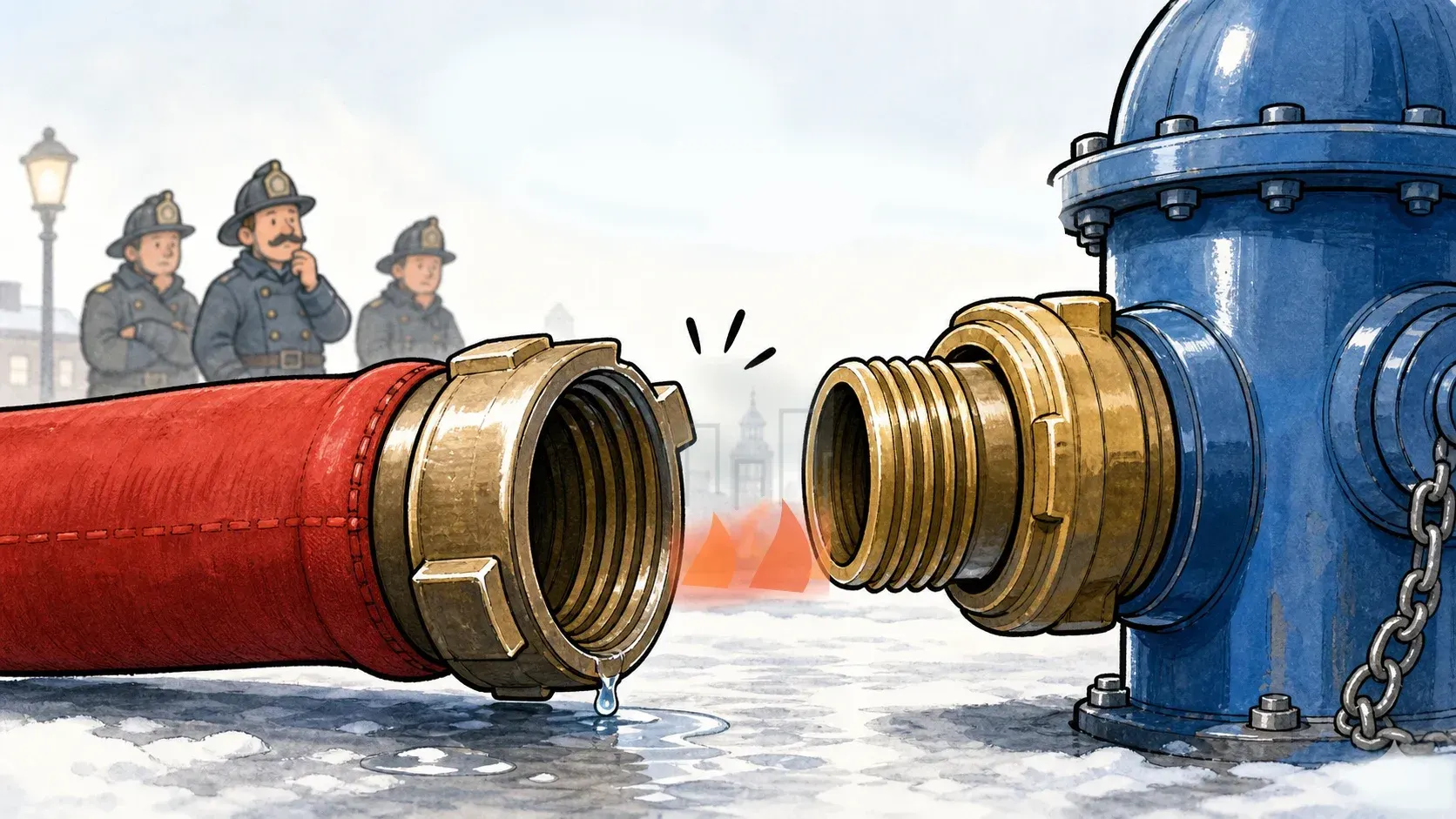
On the morning of February 7, 1904, fire crews from Washington, Philadelphia, and as far off as New York loaded their pumpers onto railroad flatcars and raced to Baltimore, which was on fire. When they got there, they ran their hoses to Baltimore's hydrants, and the couplings didn't fit. So a good number of those men stood in the freezing street and watched the city burn, because the threads on their hose wouldn't bite the threads on Baltimore's plugs.
The fire took thirty hours and leveled more than 1,500 buildings across seventy blocks of downtown, some 140 acres. Thirty-five thousand people lost their jobs in a weekend. Adjusted forward, the loss runs north of five billion dollars. It's still the third-worst urban conflagration in American history, behind only the Great Chicago Fire and the San Francisco quake. And the craziest thing is that the water was there, the pumps were there, and the firefighters were there. What stopped them were several hundred thin sheets of metal that made up the threading on fire hydrants. By 1903 the United States had more than six hundred different sizes and variations of fire-hose coupling.
Six. Hundred.
Ask yourself how a country ends up with six hundred incompatible ways to attach a hose to a water source, and you get to the real lesson, which has nothing to do with fire. The incompatibility wasn't an accident or an oversight; manufacturers patented their own couplings and guarded them. This made every city forced to sink real money into whatever system it already owned. The standards efforts that had been kicking around since the 1870s went exactly nowhere, because the people who would have had to adopt a standard were doing fine without one and the people selling the equipment made more money when you couldn't take your business across the street. (W3C and IETF folks, I KNOW you are shaking your heads right now). It took an enormous disaster to expose a market structure where proprietary couplings were more important than safety.
I'm now supposed to say "and isn't that just like the cloud," and the irritating truth is that it is, in almost perfect detail. Your data sits in one provider's object store, in their preferred table format, and the day you decide to move it to a competitor you discover the coupling: the egress fee on the way out, the proprietary format that needs translating, the API that is almost but not quite the one next door. It's the hose that won't thread onto the other guy's hydrant, and like the 1904 version, it is engineered to not fit. Brussels finally lost patience with it, and the EU Data Act bans cloud switching fees outright as of January 12, 2027, caps the notice period for leaving at two months, and forces providers to publish a full list of the data categories you're allowed to take with you when you go. That is, almost word for word, a fire-hose coupling standard, about 122 years after the lesson learned by the National Fire Protection Association.
But the Baltimore story does not end with "and then they fixed it." After 1904 the NFPA did the obvious thing and published a national standard coupling. A century later, a NIST study went and checked, and found that only 18 of the 48 largest American cities had actually adopted it. Thirty cities, a hundred years on, were still running their own thread. The standard has been put in place! It's been around FOR A CENTURY. But inertia is still winning today. The 1991 Oakland Hills firestorm burned hotter and longer in part because Oakland's hydrants used a three-inch coupling while the mutual-aid crews showed up with the two-and-a-half-inch national standard. Twenty-five people died in a fire made worse by a thread mismatch, eighty-seven years after Baltimore made that exact lesson free for anyone willing to read it.
So while you CAN say "standardize everything," but that's just not enough. A world where every system speaks one format and routes through one provider is a world where a single bad config push knocks everyone flat at the same instant, which happens ALL the time (I'm not providing links, because i don't want to shame people, but search yourself; no matter what date you are reading this - today or ten years from now - I will bet dollars to donuts that there's a "down time" notice from a major provider in the past week). The real lesson is narrower and more annoying than "pick a standard." It's that the failure is almost never inside the box. It's in the coupling between boxes, the seam everyone treats as a tedious detail because it's boring and it's somebody else's job. Baltimore had no shortage of water. The cloud has no shortage of compute. What neither one reliably had was a connection that worked when it actually mattered, owned by someone whose business depended on it working rather than on it quietly not.
We are very good at building magnificent boxes. We ship the seams as an afterthought, or worse, as a moat. Mayor McLane stood in the ashes in 1904 and told the cities offering help that "Baltimore will take care of its own, thank you." It's a great line. It's also what every cloud contract says to you, in much smaller type, on the way in.
Want to learn how intelligent data pipelines can reduce your AI costs? Check out Expanso. Or don't. Who am I to tell you what to do.*
NOTE: I'm currently writing a book based on what I have seen about the real-world challenges of data preparation for machine learning, focusing on operational, compliance, and cost. I'd love to hear your thoughts!