The Map Is the Moat
In mid-June, Google, Microsoft, Salesforce, NVIDIA, and half a dozen others shipped a standard for how AI agents find the tools they can use. OpenAI and Anthropic aren't on it. The two most famous names in AI got left off the map of AI, and that was the entire point.
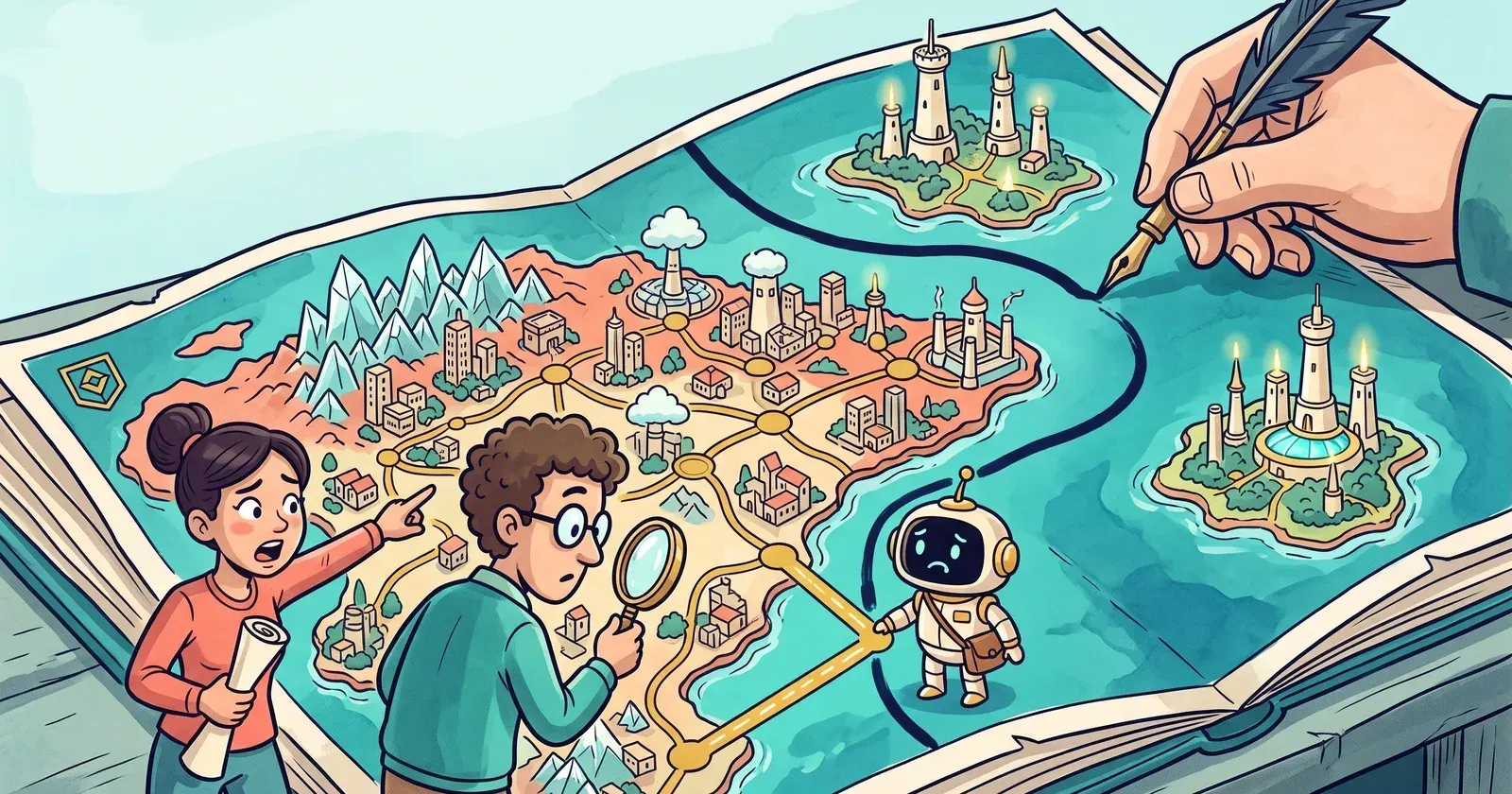
On June 17, a coalition of the biggest names in enterprise software published a new open standard called Agentic Resource Discovery, ARD for short. Google, Microsoft, and Salesforce headlined it, with Cisco, Databricks, GitHub, Hugging Face, NVIDIA, ServiceNow, and Snowflake signing on. The stated goal is boring in the way that important infrastructure is always boring: a common way for an AI agent to find out what tools and other agents exist and how to call them, so nobody has to hand-wire every connection between every piece of enterprise software. It is the latest in a run of big-tech moves to set the open standards for agentic AI, and on the surface it looks like more of the same cooperative plumbing.
The two companies not on the list are OpenAI and Anthropic, which, seems like a pretty big miss.
Strip the branding off ARD and you are looking at service discovery - an area I spent quite a bit of time on with Kubernetes and know and love since distributed systems have needed since there were two computers to introduce to each other. A service comes online and has to announce what it is and where it lives, and other services have to be able to look it up without someone editing a config file by hand. DNS is service discovery for hostnames, while Consul and etcd and ZooKeeper are service discovery for microservices. ARD is the same primitive aimed at agents and tools: each organization publishes an ai-catalog.json manifest under its own domain, an agent describes what it is trying to do, and the discovery layer tells it what is available to do it with. Federated, Apache-licensed, hosted under the Linux Foundation, no single company owning the registry.
This, in a lot of ways, could be the new Google (or Yahoo, depending how old you are). Whoever controls how services find each other controls which services get found which is pretty fucking powerful, since the thing that resolves names decides what is allowed to exist. A service that isn't in the registry is a service that, functionally, is not there. Put another way, it's a map, and the map is the moat, and the enterprise incumbents are taking a stab at deciding how you draw it.
People have already been circling around this. Anthropic gave the world the Model Context Protocol in late 2024, which standardized how an agent connects to a tool, and it was good enough that everyone adopted it, all the way to 10,000-plus public servers and 80% of the Fortune 500 touching it within a year. Google shipped Agent2Agent for how agents talk to each other. Both of those layers eventually got donated to the Linux Foundation. And while the labs sit on the governance of how agents connect and how agents converse, the ARD stakes out the one layer above both, the catalog of what is worth connecting to in the first place. It's not ALWAYS binary, but this is a move that lets the more traditional enterprise folks (Google, Microsoft, Salesforce, Snowflake, etc etc) push what they already own. The labs have every incentive to push another angle, since the enterprise folks are trying to redraw the boundary of the fight to a place where they hold the land, where the labs only show up as entries in a directory somebody else defines.
There is a second, sharper move buried in the design, and it is a bet against the labs' entire product surface. ARD assumes the agent discovers and calls tools on its own, without a conversational interface as the bottleneck. Read that as what it is: a wager that the chatbot, the thing OpenAI and Anthropic have built their enterprise businesses around, is not where real work will happen, right as the two labs are visibly pulling in different directions on what an agent should even be. In the ARD worldview the chat window is a demo, and the actual economy is agents quietly resolving a procurement request against the approval system and the budget tool and the vendor database with no human typing in a box. If that bet is right, the most valuable real estate in enterprise AI is the registry, not the model, and the registry is the thing the labs conspicuously do not have.
Now, credit where it's due, because this is solid engineering and a real fix for a real problem. Before a discovery standard, every autonomous workflow is bespoke integration, hand-built and brittle, which is most of why "agentic AI" has been a great demo and a miserable production system. A federated catalog you publish under your own domain, keeping control of what you expose and to whom, is the correct architecture. It keeps the description of your capabilities next to your capabilities instead of shipping the whole map to a vendor who rents it back to you. I have argued for a while that any catalog that lives away from the thing it describes is a catalog that is already wrong, and a federated, locally-owned manifest is the first design I've seen from the majors that takes that seriously.
But the word "federated" is doing a lot of work, because the history of federated systems is the history of things that were going to stay decentralized and didn't. Email is federated, and most of the world's mail now flows through a handful of providers who decide what counts as spam. DNS is federated, and there is still a root, and there are still registrars, and there is still an afternoon where a name can stop resolving. A2A's own pitch is that it mitigates vendor lock-in, which is precisely the promise every federation makes on day one. Federation describes where the data sits, not where the power settles, and power settles wherever the defaults are set. If ARD becomes how agents find things, then a tool that does not publish an ARD manifest becomes invisible to every agent that uses it, and the companies that authored the schema and ship the most popular catalogs get to define what "discoverable" means. The quieter fight underneath all of this is not who runs the agent but what you are allowed to take back out, and a discovery layer is where that gets decided first. Apache 2.0 licensing means nobody can charge rent on the standard itself. It says nothing about who benefits when your agents reflexively discover Workspace, M365, and Salesforce first.
So the fight nobody framed correctly at the time is not model versus model. It is the layer that owns the enterprise's tools and data drawing a border against the layer that owns the models, and choosing to fight it at the map. Whether you build agents or just buy them, the question worth asking your vendors is not whose model is smartest. It is who controls the directory your agents read before they do anything at all, and whether the map of your own capabilities is something you own or something you have quietly agreed to rent. Being left off that map is what OpenAI and Anthropic are worried about this month. Eventually it is what you should be worried about too.
Want to learn how intelligent data pipelines can reduce your AI costs? Check out Expanso. Or don't. Who am I to tell you what to do.
NOTE: I'm currently writing a book based on what I have seen about the real-world challenges of data preparation for machine learning, focusing on operational, compliance, and cost. I'd love to hear your thoughts!