The Cheapest Connection You Never Build
FERC just ordered the grid to fast-track AI data centers and make them pay for their own hookups. But you can itemize the wire. You can't itemize the scarcity, and that one clears at the margin, for everybody.
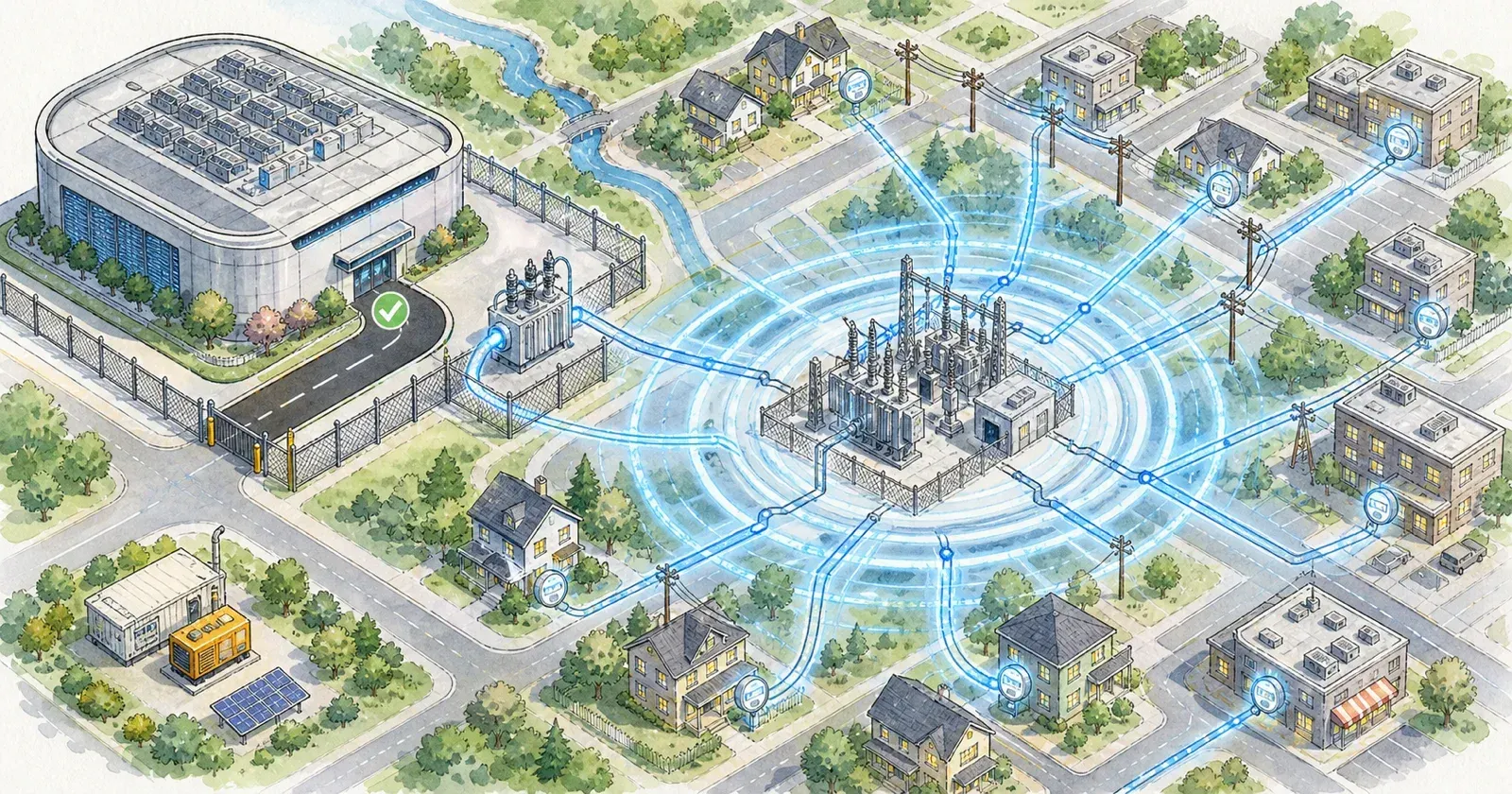
On June 18, FERC stopped studying the data center power problem and started issuing orders about it. No notice of proposed rulemaking, no request for comment, none of the usual multi-year administrative slow walk. Instead, six show cause orders under Section 206 of the Federal Power Act, aimed at the six organized markets that keep the lights on for roughly 200 million Americans across more than thirty states: PJM, MISO, SPP, the California ISO, ISO New England, and the New York ISO. Each operator gets 30 days to account for its spare capacity and 60 to defend or rewrite its rules, with the goal being to get big loads onto the grid fast, or let them co-locate with their own generation, and either way, stop sticking ordinary ratepayers with the bill.
There's a great reason for this decision; the interconnection queue in this country is genuinely broken. Getting a large load connected can take years, and by Bloomberg's reporting PJM now projects it will be six gigawatts short of its own reliability requirement by 2027, while wholesale electricity has climbed as much as 267% against where it sat five years ago. Data center demand, for its part, is on track to nearly triple through 2035. Back in April I wrote about eleven gigawatts of announced capacity sitting frozen because the grid physically could not deliver the power. So FERC moved. This is good.
And the ratepayer protection is also good! Ish. If you want priority access, you pay for it. The data center pays for its own interconnection: the wire, the substation, the transformer, the steel. This kills a real and ugly abuse, where a utility quietly smears a hyperscaler's hookup costs across every residential meter in the region and calls it the cost of doing business. Fixing that is worth doing, and FERC deserves credit for doing it under threat of a federal enforcement deadline instead of a strongly worded letter.
But the interconnection cost is the part you can itemize, and the part you can itemize is the cheap part. The expensive part has no line item, and it cannot be assigned to anyone, because a grid is a shared pool and the price clears at the margin. When you bolt six gigawatts of new demand onto a system that is already six gigawatts short, the marginal price moves for every single person drawing off that pool. The data center can write a check for its on-ramp, but it cannot write a check for the price of the electricity it just bid up, because that cost never arrives as an invoice. It arrives as everyone's rate. That 267% did not happen because some grandmother in Toledo had her interconnection mispriced. It happened because demand outran supply in a market that prints exactly one clearing price for all of us. In other words, FERC can ring-fence the wire, but physics does not recognize the fence around the scarcity.
If we needed evidence of this, six days later, the same PJM agreed to bolt a new capacity advisory onto its emergency playbook, which is basically a way to warn its 67 million customers that supply can run short now even on ordinary days, without the heat waves that used to be the only thing that rationed power. That is the operator conceding, in its own paperwork, the part the order cannot itemize. The scarcity is already here, it is shared, and it does not read the invoice.
I like to think of this as a "new stadium" problem, basically. You can make a new stadium for a city pay for its own parking structure and its own freeway on-ramp and then stand at the ribbon-cutting and announce that on game day there will be no troubles getting here to enjoy your $73 beer, hotdog, and soft serve out of a plastic helmet. But every road for ten miles received no upgrades whatsoever, and was certainly not the budget, received no zoning variance, and, generally, will just degrade much more quickly. And the people who will eat it are the ones six blocks away who were sitting at home PROBABLY watching the game on tv (which is what they were doing before the new stadium went in anyway). We have spent a century learning that the parking lot is never the part of the development that costs the neighborhood something. The road is.
The whole order reveals - starkly - that the bigger assumption is that the demand should be measured by the shared grid, not the interconnects. I really like the colocation option which says fine, go sit next to your own generation (in the stadium scenario, this would be the equivalent of adding some a high rise hotels where you could just walk to the stadium since it's right next door). The cheapest interconnection in the world is the one you never have to build, because the load already lives where the power is. Compute that sits next to its own power doesn't bid up grandma's rate, because it isn't standing in grandma's line. That is not a regulatory trick. It's just where the physics has been pointing the entire time, and it is the opposite of hauling a gigawatt of demand three states over to a substation that was already maxed out.
NVIDIA, for its part, published a blog the same week calling the FERC orders a win for affordability. The orders may well be. The only question worth asking is affordability for whom, and the invoice, conveniently, doesn't say.
Want to learn how intelligent data pipelines can reduce your AI costs? Check out Expanso. Or don't. Who am I to tell you what to do.
NOTE: I'm currently writing a book based on what I have seen about the real-world challenges of data preparation for machine learning, focusing on operational, compliance, and cost. I'd love to hear your thoughts!