Painted Seams
Apple raised Mac and iPad prices up to 25% this month and the machines did not change. The AI buildout requisitioned the world's memory the way 1942 requisitioned silk for parachutes, and this time there is no ration coupon, just a bigger price.
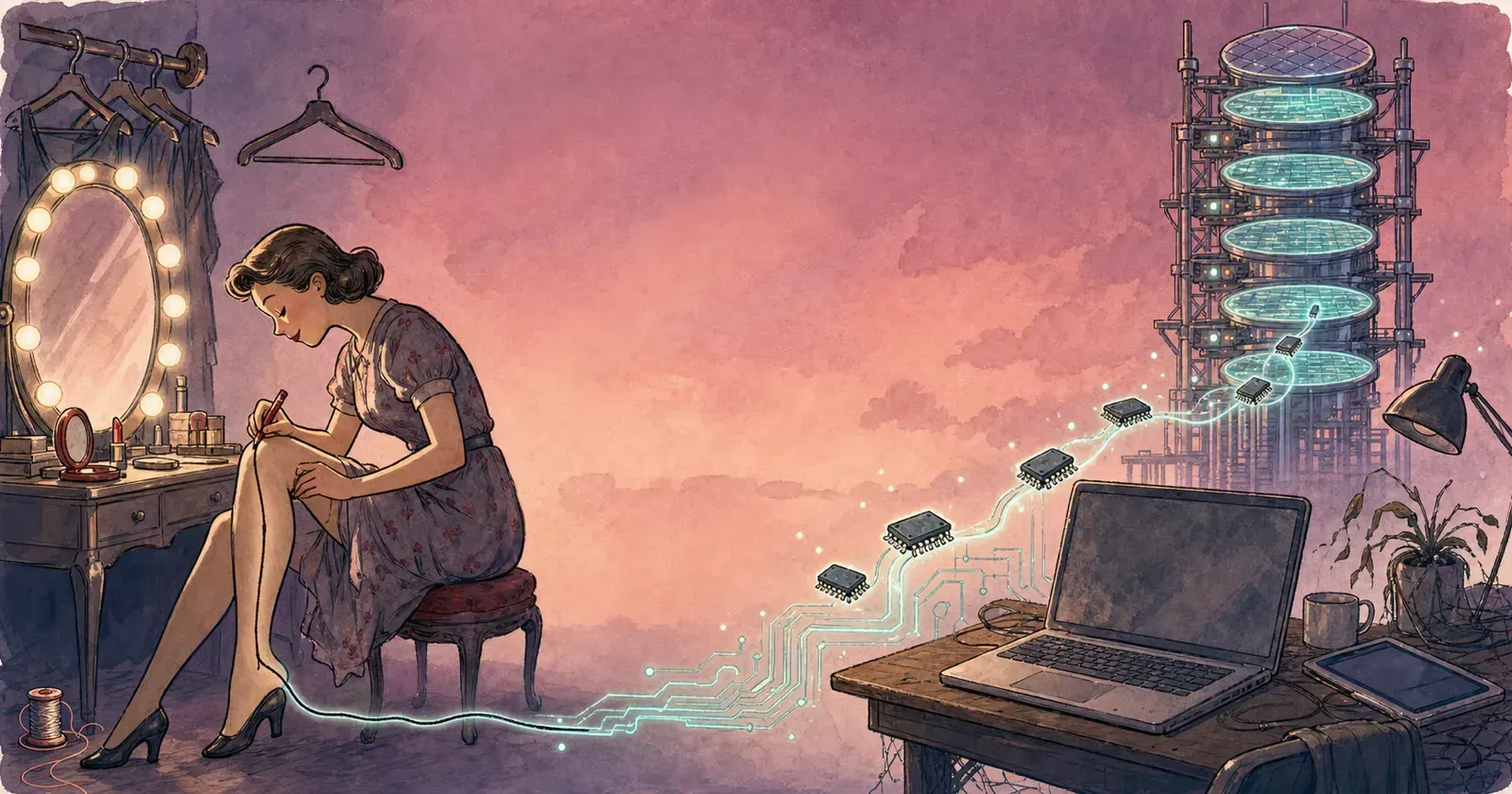
Apple raised the price of a Mac and an iPad this month, somewhere between 15 and 25% depending on the configuration, and the machines did not get better. Sadly, the thing that made it more expensive doesn't even get to be part of a keynote: the memory. Framework jacked up its DDR5 upgrade prices by half. And they aren't the only ones: Dell warned of hardware increases measured in hundreds of dollars; and back in February, Micron quietly retired Crucial, the consumer memory brand a whole generation of people who built their own PCs grew up on, so it could point every wafer it makes at enterprise AI. If you have shopped for a laptop lately and felt like you were being mugged, you were not imagining it, and it has almost nothing to do with the laptop.
The mechanism is cleaner and crueler than a shortage.
One bit up top, three bits gone below
One thing to understand is the topology of a machine (or cluster) that supports ML is very different than even the God Box you may have sitting out under your desk. The AI buildout wants high-bandwidth memory, HBM, the exotic stacked stuff that feeds a GPU, and there are (for now anyway) exactly three companies on the planet that can make it: Micron, SK Hynix, and Samsung. The catch is that HBM and the plain DRAM in your phone come off the same fabs and the same finite pile of wafers. When Micron commits a wafer to an HBM stack, it forgoes roughly three bits of the conventional memory it could have sold to everyone else. As a result, HBM has quietly grown to claim around 23% of all DRAM wafer output, up from 19% a year earlier, and every point of that came out of the supply that used to go into cheap laptops, mid-range phones, game consoles, and the SSD in your camera.
So the price did what prices do when a giant new buyer corners a fixed supply. Consumer DRAM ran up as much as 90 to 95% quarter over quarter in the first three months of 2026 alone. Contract DRAM prices were up more than 170% year over year heading into the year, and enterprise SSDs doubled. Gartner is telling buyers to brace for a 130% memory cost surge, Bloomberg has been calling it a genuine crisis since February, and IDC does not expect real relief until new fabs come online in 2027 or 2028. Intel's Lip-Bu Tan put it more bluntly: no relief until 2028. Two full years in which the memory inside a device that has nothing to do with AI costs more because of AI.
And the allocation is already locked. Micron's entire 2026 HBM output sold out under binding contracts before the year even started, some of it under multi-year deals that lock in roughly $100 billion in minimum contracted revenue and $22 billion in upfront customer cash. What you have is a perfect storm of supply chain constraints; the consumer is not being outbid in a live auction, and so has no say in the price. Instead, they are last in a line that was already full when the doors opened.
The stockings went to the parachutes
There is a rhyme here, and it is not from the chip industry.
In 1942, nylon and silk stopped showing up in American stores, and the reason was not that DuPont had forgotten how to make them. The War Production Board requisitioned the material for parachutes, glider tow ropes, and powder bags. Silk stockings, the small everyday luxury of an entire generation of women, simply vanished, and the vanishing had nothing to do with anyone's feelings about stockings. It was a straightforward consequence of a bigger buyer with a bigger priority taking the whole supply. The famous part is what people did about it; they drew seams up the backs of their bare legs with eyeliner to fake the look of a stocking that no longer existed. Painted seams; a cosmetic workaround for a supply chain that had been pointed somewhere else.
That is where the consumer memory market sits in 2026, minus the war and minus the ration book that at least made the trade honest. In 1942 the government stood up and said out loud that the material was going to the front, and it handed you a coupon so you understood the deal. In 2026 there is no declaration and no coupon. There is just a price, and a laptop that costs 25% more for reasons the person at the counter cannot explain, and a memory maker retiring its consumer brand rather than say in plain words that you are no longer the customer.
The shape of the demand is the problem
It is true that memory has always been cyclical, gluts and shortages are the heartbeat of that industry, and the fabs really are coming in 2027. But the cyclicality is showing up elsewhere, because right now the ENTIRE STACK is cyclical. The electric bill and the model that just got eaten from the bottom are showing the exact same characteristics. Turns out when you concentrate an enormous demand into one synchronized spike aimed at one finite shared resource, the shock does not stay where you put it. It radiates until it finds the person who never placed an order and hands them the bill, whether the resource is wafers or watts.
A single, centralized, all-at-once draw is the thing that breaks a shared pool. It was true of the grid in one Virginia county and it is true of three fabs in Asia. Spread the demand across time and place and the same total consumption stops being a crisis and goes back to being a line item. That is the physics of shared resources, and we keep relearning it the expensive way, one requisition at a time.
Your kid's laptop went to war this year. Nobody told you, because this time there was no coupon to hand out. Just eyeliner, and a longer wait for the seams to come back.
Want to learn how intelligent data pipelines can reduce your AI costs? Check out Expanso. Or don't. Who am I to tell you what to do.
NOTE: I'm currently writing a book based on what I have seen about the real-world challenges of data preparation for machine learning, focusing on operational, compliance, and cost. I'd love to hear your thoughts!