The Donation Bin
A Bellevue recycler found rare aerospace hardware with little context about its origins. The components survived; the records that would explain them did not arrive with the donation. Cheap storage helps us keep artifacts, but preserving their meaning takes deliberate work.
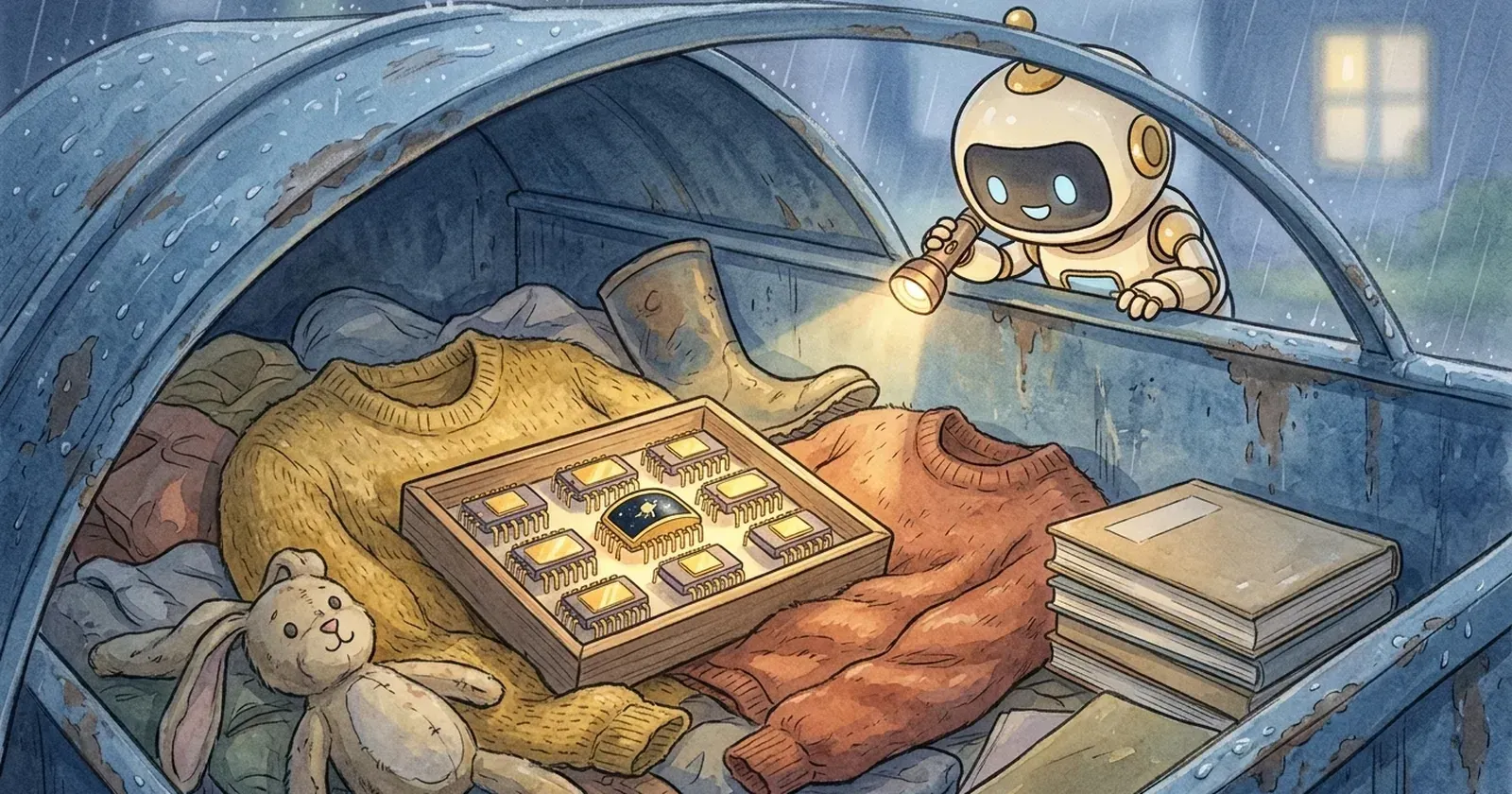
A recycler in Bellevue, Washington, opened one of his donation bins in July expecting the usual: dead laptops, tangled cables, and a printer somebody was too embarrassed to sell. Instead, he found a radiation-hardened Texas Instruments SBP9900X microprocessor from 1977, stamped "Experimental," the family of chips that flew in missile guidance and deep-space hardware. Next to it, an 8x8 optical star coupler from Canstar, a component from the era when "fly-by-light" aircraft controls were a laboratory bet. And around those, a scattering of hand-built hybrid microcircuits, gold wire bonds laid down by a human being at a microscope, the signature of thirty years of military and aerospace engineering somewhere in the Seattle area.
No paperwork. No notebooks. No names. Nothing. Tyler Rivers, who runs the recycling outfit, is an economics grad with no aerospace background, and he set out to figure out who built these things and why. GeekWire's July report left those questions open.
Bunnie Huang, the hardware hacker, looked at the photos and guessed it was a collage of souvenirs a technician kept from various projects. Perhaps a technician retired or died, and somebody cleared a garage. Which makes sense, but it's kind of crazy we don't know. The objects span decades of engineering work, and because their provenance did not arrive with them, their survival depended on one curious recycler recognizing what was in the bin. In this case, preservation depended on someone noticing what had been thrown away.
The bin decides.
We are the most storage-rich civilization that has ever existed. Standard object storage is cheap enough to make retention an easy default, and so we keep everything: exabytes of debug logs nobody will ever read, seven years of clickstream from a product that shipped its last release in 2019, and every intermediate table of every pipeline, retained forever because deletion requires a meeting and storage does not. Meanwhile, the irreplaceable stuff—the annotated schematic, the prototype with the hand-laid gold bonds, and the engineer who remembers why the third revision moved the coupler—has no budget line, no bucket, and no lifecycle policy except the estate sale.
We often keep the logs and lose the engineering without making either choice explicit. Keeping is a decision, and we have delegated it to defaults. The default for bits is retain, because it's cheap and nobody gets fired for a full bucket. The default for atoms, and for the context in people's heads, is the bin. So the archive fills up with the stuff that was easiest to keep, whether or not it was worth keeping.
And notice what actually makes the Bellevue trove a mystery. The silicon survived. Those chips were built to survive radiation that would scramble anything in your phone. What's gone is the metadata: whose bench, which program, and what problem was the experimental part experimenting on? The bits survived, and the lineage died, and without the lineage, the bits are just very well-made shrapnel. Every organization I talk to is sitting on petabytes that are one retirement, one reorg, and one "who owns this table?" away from being gold wire bonds in a donation bin: perfectly preserved, meaning discarded. I've written before about why catalogs drift out of truth; this is the endgame of that drift, just with a fifty-year fuse.
Three ways to lose what you kept
NASA spent three years searching for the original slow-scan tapes of the Apollo 11 moonwalk, the highest-quality recording of the most-watched event in human history, and concluded in 2009 that they had probably been erased and reused for Landsat satellite data sometime in the early eighties. Not stolen. Not burned in a fire. Taped over, because magnetic tape was expensive, the erase-and-reuse policy was the default, and the moon landing was, by then, old news.
Or take the F-1, the engine that put the whole thing up there. When NASA engineers wanted to revisit it in the 2010s, the blueprints still existed. Drawings alone could not convey every manufacturing decision. Engineers examined surviving hardware, scanned it, and test-fired its gas generator, with help from heritage Rocketdyne engineers who remembered the work. Recovering the knowledge took both the artifact and the people who could explain it.
My favorite version, though, is the BBC Domesday Project. In 1986, the BBC celebrated the 900th anniversary of the Domesday Book by building a new one: a national survey of Britain, contributed by a million people, published on state-of-the-art laserdiscs. By 2002, the specialized computers and drives needed to read the discs had become rare, and preservation projects turned to emulation to keep the material accessible. The original Domesday Book, written on parchment in 1086, remains perfectly legible at the National Archives. The eleventh century out-archived the twentieth by roughly nine hundred years.
Back in Seattle, the stuff that ends up at the Museum of Flight got there because, at some specific moment, a specific person made an active decision to keep it and wrote down why. That decision is the whole difference between an archive and a landfill.
And decisions get unmade. The city had a museum built for exactly this kind of hardware, Paul Allen's Living Computers: Museum + Labs. It closed at the start of the pandemic, never reopened, and in 2024 Christie's auctioned the highlights while the rest went to a museum near Atlanta. Its former director told GeekWire that most museums would not exist without collectors, people who look at a box and say, "Well, that seems like it's worth keeping." Rivers is doing archaeology on nearly fifty-year-old hardware because its context did not arrive with the hardware. Somebody, someday, is going to do the same thing to your data lake.
Check your defaults. And if you recognize the gold bond work, GeekWire asked readers to get in touch.
Want your data to keep its lineage attached while it's processed, instead of reconstructing it later like a crime scene? Check out Expanso. Or don't. Who am I to tell you what to do?
NOTE: I'm currently writing a book based on what I have seen about the real-world challenges of data preparation for machine learning, focusing on operational, compliance, and cost. I'd love to hear your thoughts!